What to Track in Google Analytics for Service Websites
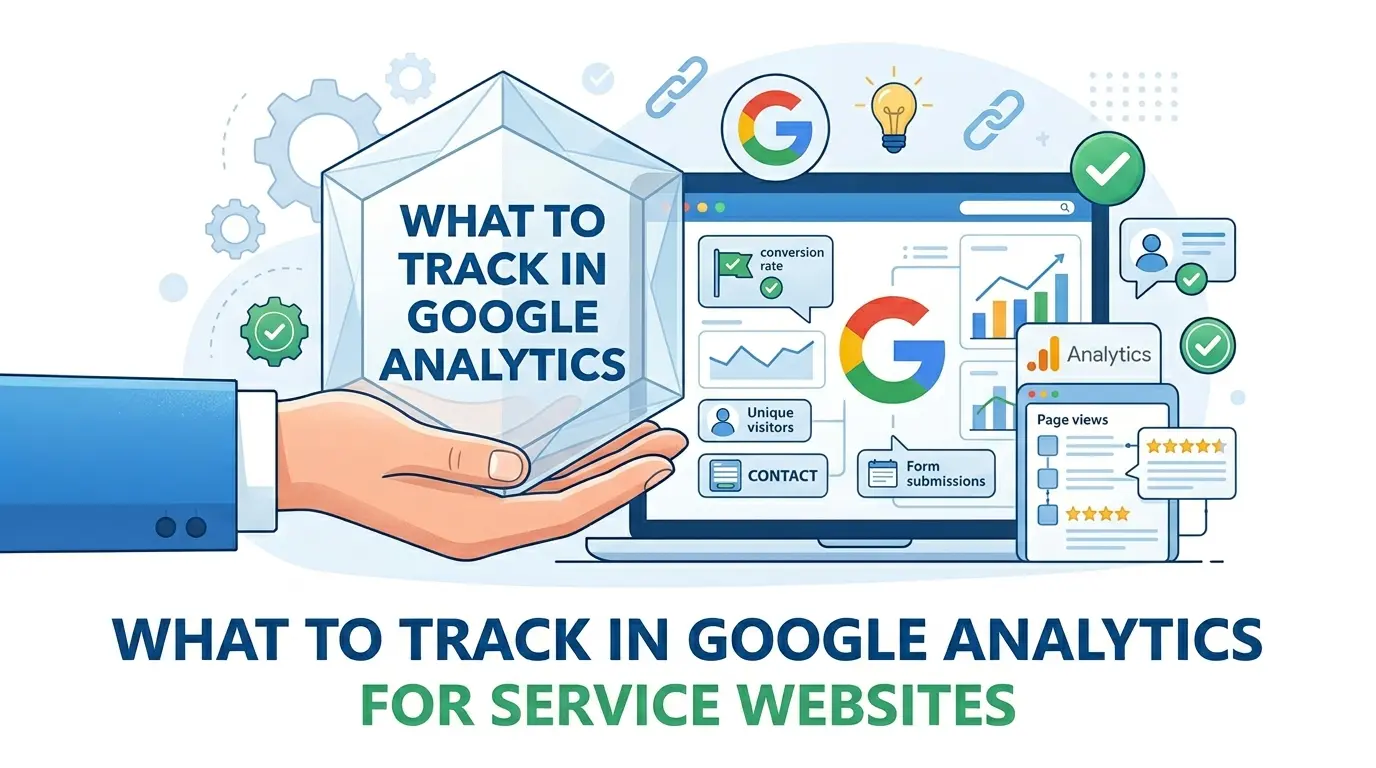
A focused analytics setup that prioritizes lead quality and funnel behavior over vanity metrics.
Measure decisions, not dashboards
Analytics should answer operational questions: Which channels generate qualified leads? Which service pages create action? Where does the funnel lose momentum?
Essential events
- Primary contact form submissions
- Click-to-contact actions (email, phone, chat)
- Service page CTA clicks
- Checkout initiation and completion
When tracking reflects business outcomes, optimization becomes faster and more focused.
Context: why this topic affects revenue
In service businesses, website decisions are rarely isolated technical choices. They influence sales cycle speed, client trust, and acquisition efficiency. Teams that treat analytics implementation and reporting as a strategic system usually outperform teams that treat it as a one-time task. The practical objective is to align user experience, business process, and measurable outcomes.
The most common failure pattern appears when teams optimize for what is visible instead of what is effective. A page can look modern and still underperform if buyers cannot understand the offer quickly, assess proof, and move to the next step with confidence. This is exactly why conversion attribution quality and faster decision cycles should be tracked from day one.
Who this guidance is designed for
This framework is built for teams who need marketing data tied to revenue outcomes. It is intentionally operational: each recommendation can be translated into a checklist, owner, and review cadence. If your current process relies on ad hoc decisions or urgent fixes, this structure helps you shift toward predictable execution.
Most teams already know what good outcomes look like. The challenge is sequencing work so improvements accumulate instead of competing with each other. Strong execution comes from clear ownership, simple rules, and frequent review against real user behavior.
Diagnostic checklist before making changes
- Is the main business objective of the page or workflow explicitly defined?
- Can users understand the offer in less than five seconds?
- Do analytics events represent actual business steps rather than vanity interactions?
- Is there a clear owner for content quality and technical reliability?
- Do we have documented assumptions that can be tested in production?
If two or more answers are unclear, optimization should pause until decision criteria are explicit. Without criteria, teams often ship changes that look active but do not improve business outcomes.
Execution model that scales
A reliable model is to work in short cycles with one priority theme per cycle: clarity, trust, performance, or conversion friction. This prevents fragmented updates and helps teams measure cause-and-effect. When multiple teams contribute, define one accountable owner per cycle and one review document shared across stakeholders.
Keep changes intentionally small but outcome-focused. For example, improving headline clarity, CTA intent, and social proof positioning in the same release often produces a larger lift than broad visual changes with no hypothesis. The key is linking every edit to conversion attribution quality and faster decision cycles so learning compounds over time.
Common mistakes and how to avoid them
Mistake 1: Treating this as a design-only or SEO-only task. Fix: integrate product, content, and analytics decisions in one plan.
Mistake 2: Publishing large changes without baseline measurements. Fix: capture conversion and engagement baselines before deployment.
Mistake 3: Prioritizing volume over quality. Fix: optimize for qualified actions and downstream sales outcomes, not only top-funnel metrics.
Quality standards for teams and agencies
Define non-negotiable standards for copy clarity, technical QA, mobile behavior, and analytics fidelity. Quality standards reduce review friction because teams evaluate work against shared criteria instead of personal preference. This is especially important when several people edit content over time.
Documentation should be concise and actionable: what changed, why it changed, and what metric should move if the change works. This habit turns website improvement from reactive work into a measurable operating capability.
30-day improvement plan
- Week 1: baseline measurement, issue prioritization, owner assignment.
- Week 2: implement highest-impact content and structure updates.
- Week 3: refine technical elements and conversion flow friction points.
- Week 4: evaluate outcomes, document learnings, and prepare next cycle.
This cadence is realistic for lean teams and robust enough for agencies managing multiple pages. Consistency matters more than intensity.
How to evaluate success
Success is not a single metric spike. It is stable improvement in conversion attribution quality and faster decision cycles, paired with better qualitative feedback from real users and sales teams. If conversion rises but lead quality drops, the message is attracting the wrong audience. If engagement rises without action, the path to conversion likely needs simplification.
The goal is sustainable performance: clear communication, trusted execution, and measurable business impact. Teams that review outcomes monthly and iterate with discipline usually create a durable competitive advantage.
Operational note 1: teams should review assumptions with sales feedback, verify event tracking accuracy, and keep content updates aligned with the actual buyer journey rather than internal jargon. This continuous alignment improves decision quality and prevents performance drift over time.
Operational note 2: teams should review assumptions with sales feedback, verify event tracking accuracy, and keep content updates aligned with the actual buyer journey rather than internal jargon. This continuous alignment improves decision quality and prevents performance drift over time.
Operational note 3: teams should review assumptions with sales feedback, verify event tracking accuracy, and keep content updates aligned with the actual buyer journey rather than internal jargon. This continuous alignment improves decision quality and prevents performance drift over time.
Operational note 4: teams should review assumptions with sales feedback, verify event tracking accuracy, and keep content updates aligned with the actual buyer journey rather than internal jargon. This continuous alignment improves decision quality and prevents performance drift over time.
Operational note 5: teams should review assumptions with sales feedback, verify event tracking accuracy, and keep content updates aligned with the actual buyer journey rather than internal jargon. This continuous alignment improves decision quality and prevents performance drift over time.
Ready to build something great?
Let's turn your idea into a powerful digital product. Get a free consultation today.